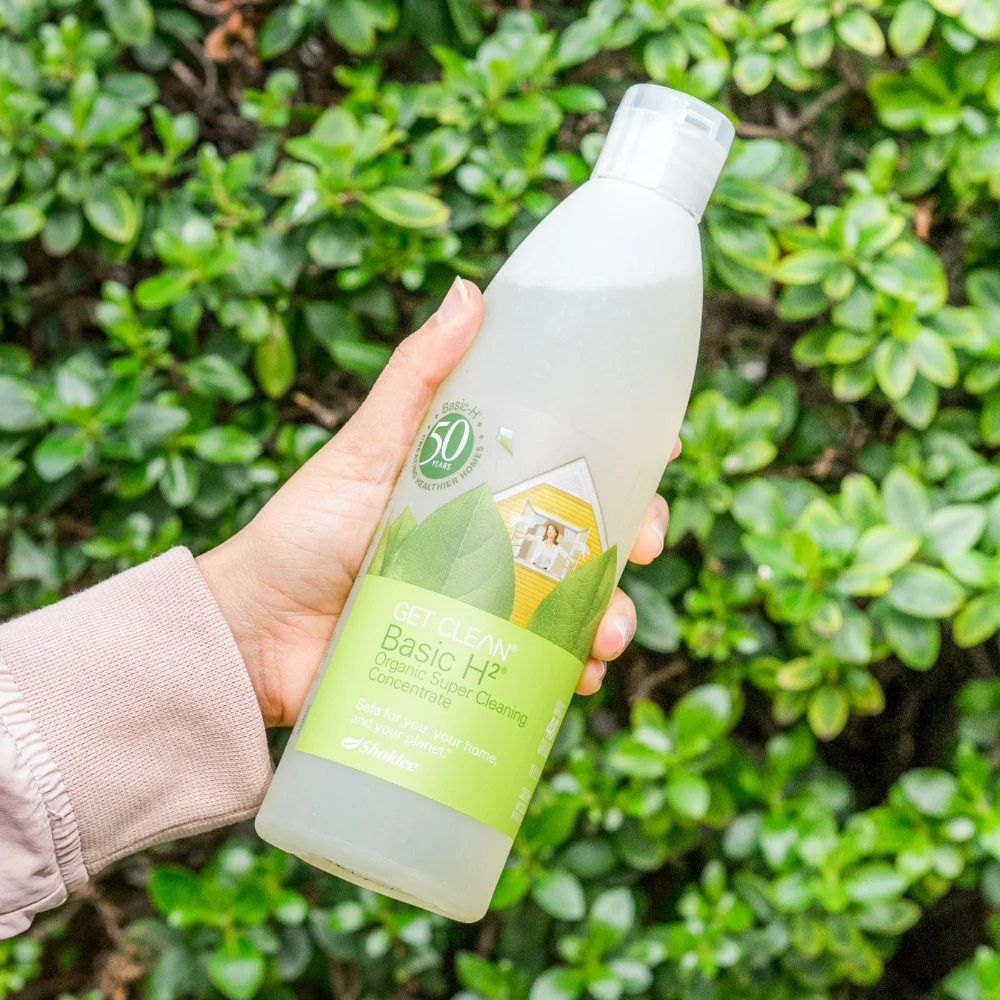
We tend to think of “clean” as a smell, but that ‘perfumed clean smell’ is often part of the problem, not the proof. Many conventional cleaners fill your home with volatile compounds and residues you then breathe, touch, and absorb. Non-toxic cleaning products promise the same clean without that trade-off. This guide explains what “non-toxic” actually means, which ingredients are worth avoiding, and how a 70-year-old green cleaning line, Shaklee’s Get Clean and Basic H, fits in.
Why your cleaning cabinet matters more than you think
The U.S. Environmental Protection Agency has reported that indoor air can be more polluted than outdoor air, and that the products we use indoors are a meaningful contributor. Cleaning products are used on the surfaces you eat from, the floors children crawl on, and in small, often poorly ventilated rooms like bathrooms. Whatever is in them doesn’t simply vanish, it lingers on surfaces and in the air. That makes the cleaning cabinet one of the easiest places to reduce avoidable chemical exposure in a home.
Ingredients many people choose to avoid
“Non-toxic” isn’t a tightly regulated label, so it helps to know what cleaner-conscious shoppers actually look to avoid:
- Ammonia and chlorine bleach, strong respiratory irritants; dangerous if accidentally mixed (they can form toxic gases).
- Phosphates, historically linked to algal blooms that harm waterways.
- Synthetic fragrance, “fragrance” on a label can hide dozens of undisclosed compounds and is a common trigger for allergies and asthma.
- Quaternary ammonium compounds (“quats”), common in disinfectant sprays and wipes, and a known skin and respiratory irritant for some people.
- Certain solvents and phthalates, used in some formulas and fragrances, which is why many shoppers seek phthalate-free products.
The goal isn’t fear, it’s informed substitution. A product can be powerful and leave these out.
What “green” should actually mean
A genuinely green cleaner should check several boxes at once, not just one: safe (no harmful fumes or hazardous chemicals), biodegradable (the surfactants break down rather than persisting in waterways), concentrated (less packaging and shipping weight per use), and effective (it has to actually clean, or you’ll just use more of it). Plenty of products claim one and quietly fail the others. Concentration in particular is underrated: a concentrate that you dilute at home dramatically cuts the plastic and freight footprint of every bottle.
Shaklee Get Clean: green before “green” was a marketing word
Shaklee introduced one of the first non-toxic, biodegradable household cleaners more than 60 years ago, decades before eco-cleaning became a trend. The Get Clean® line is built on a simple promise the company phrases as “Safe for You, Your Home, and Your Planet®”: no harmful fumes, no hazardous chemicals, biodegradable surfactants, and naturally sourced ingredients.
The line’s flagship is Basic H2® Biodegradable Cleaner, and its numbers are genuinely striking:
- One 16-oz bottle makes 48 gallons of all-purpose cleaner, just ¼ teaspoon makes a full spray bottle, for roughly three cents.
- Non-toxic with no toxic fumes or hazardous chemicals, tough on grease and grime, gentle on hands.
- Over a thousand uses across washable surfaces, indoors and out.
That concentration is the environmental story in miniature: one small bottle replaces dozens of single-use plastic bottles of ready-to-use spray, with a fraction of the packaging and shipping emissions.
A clean that gives back
Shaklee’s green credentials extend past the bottle. The company was the first to be certified Climate Neutral, back in 2000, and it has a long reforestation history, it was the first company to plant one million trees around the world, in partnership with the late Dr. Wangari Maathai, the first Nobel Peace Prize laureate recognized for environmental work. Today Shaklee plants a tree with American Forests® for every Get Clean® Starter Kit sold. These are documented commitments, not vague “eco-friendly” marketing.
Switching without the overwhelm
You don’t need to replace everything in one weekend. A practical path:
- Start with the all-purpose cleaner you reach for most, it’s the highest-exposure product in most homes. Basic H2 alone replaces several sprays.
- Reuse your spray bottles, a concentrate means you refill, not rebuy.
- Add the laundry and dish products next, then specialty cleaners, as you run out of the old ones.
- Open a window while you transition, good ventilation helps regardless of what you use.
The Get Clean Starter Kit bundles the essentials for kitchen, bath, laundry, and all-purpose cleaning, and Shaklee notes you’d spend roughly $3,400 on ready-to-use cleaners to get the equivalent number of uses.*
The bottom line
Non-toxic cleaning isn’t about giving up cleaning power, it’s about getting the same results without the fumes, the questionable ingredients, and the mountain of single-use plastic. Shaklee has been making that case for over six decades, and Basic H2 remains one of the most concentrated, verifiable examples of a green cleaner that genuinely works.
You can browse the full Shaklee Get Clean green home range, start with the Basic H2 concentrate, or grab the all-in-one Get Clean Starter Kit.
Sources Cited:
1. U.S. Environmental Protection Agency. Indoor Air Quality: Improving Indoor Air Quality and Volatile Organic Compounds’ Impact on Indoor Air Quality. epa.gov.
2. U.S. EPA. Safer Choice Standard (criteria for safer cleaning ingredients). epa.gov/saferchoice.
3. American Lung Association. Cleaning Supplies and Household Chemicals. lung.org.
4. Shaklee Corporation. Get Clean® & Basic H2® product information and sustainability commitments. https://us.shaklee.com/en_US/new/Green-Home/c/500.
5. American Forests & Shaklee reforestation partnership. americanforests.org.
*Based on comparing the number of uses set forth on product labels of conventional, ready-to-use cleaners.